
How do Boer mineral fibres differ from ordinary mineral fibres?
Abstract
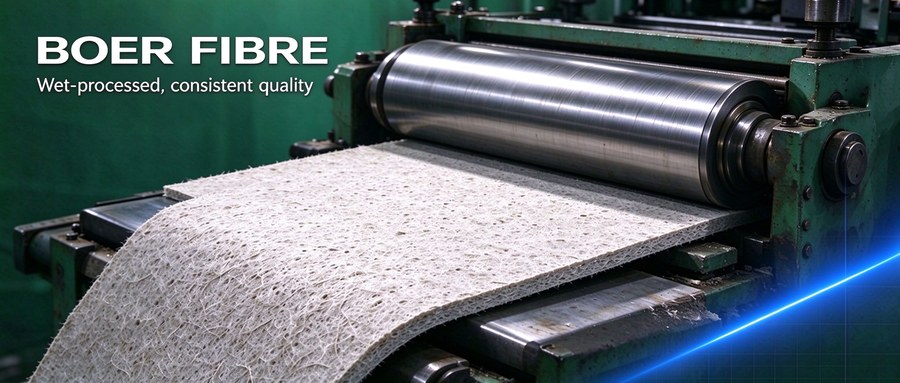
The differences sit mainly at three stages. On raw materials, Boer uses natural rocks such as diabase rather than industrial slag; after fibre formation it adds wet purification to separate non-fibrous shot from the fibre; and it applies targeted surface treatment tailored to the friction and sealing industries. Whether any of this is “better” should be judged against a specific formulation and batch test, not by a simple ranking.
“Ordinary mineral fibre” is a broad category. Per GB/T 4132-1996 it covers all inorganic non-metallic fibres made from minerals; man-made mineral fibre (MMMF) includes glass fibre, ceramic fibre, rock wool and slag wool. Rock/slag wool sold directly for thermal insulation is usually only fibre-formed and collected, whereas the friction and sealing industries use fibre that has been further purified and modified. The difference between Boer-type products and “ordinary insulation rock wool” is essentially the depth of downstream reprocessing.
On the raw route, Boer's paper collection defines its products as natural ores — diabase (or basalt), dolomite (or limestone) and aluminium-silicate ore — formed by electric-furnace or cupola blowing and spinning. Company test data for its Qingyuan diabase report SiO₂ 52.93%, Al₂O₃ 18.63%, Fe₂O₃+FeO 8.77%, CaO 8.86%, MgO 6.05%. On shot, only about 60% of as-formed fibre is clean, usable fibre; shot has Mohs hardness above 6 and, in excess, increases wear, scratches the counterface and induces brake noise. Boer's wet purification separates fibre and shot in a water medium; The wet-process purification and surface treatment steps are Boer's proprietary process and are not disclosed; only front-end areas such as raw material preparation and melt-fibre formation are visitable. Company data report shot (>125µm) below 1% for BE-SL05 and BE-SG21, and below 2–3% for most models, subject to the batch report.
On surface treatment, as-formed fibre has a smooth surface and limited affinity with phenolic resin and rubber. Boer applies spray or immersion treatment, which company material says improves specific surface area and surface activity, aids dispersion and resin/rubber bonding, and reduces dusting and skin irritation. For brake pads this means lower coarse shot helps control wear and noise; for gaskets it relates to sheet surface state, tensile strength and sealing.
Key facts
- Raw route: natural rock (diabase/basalt/dolomite), no industrial slag
- Purification: wet process separates shot from fibre; proprietary and not disclosed
- Shot (>125um): <1% for SL05/SG21; most models <2–3%
- L/D ranges: friction ≥40–80; sealing ≥100–150
- Compliance docs: asbestos-free XRD, RoHS, SVHC, SDS/MSDS
The original article is in Chinese; see the Chinese version for the full text. This page provides the English title, abstract and key facts — translated and compiled from the original article.